



Artificial intelligence (AI) is rapidly transforming health care delivery and medical education — its integration demands both enthusiasm and caution. In Tuesday’s final Keynote Series presentation of the ATS 2026 International Conference, Laurah Turner, PhD, associate dean for Artificial Intelligence and Educational Informatics at the University of Cincinnati College of Medicine, provided a framework for understanding how AI can augment, rather than replace, physician expertise.
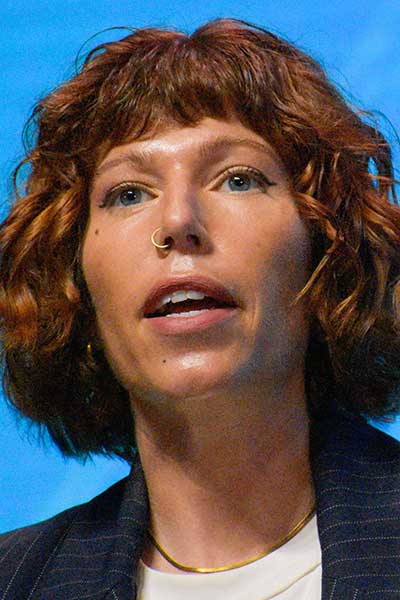
Dr. Turner highlighted a long-standing gap in clinical training: feedback. Despite extensive clinical exposure, trainees often lack timely, high-quality evaluation. As she explained, “Trainees spend thousands and thousands of hours in clinical settings, but they receive limited, high-quality feedback. Faculty actually only observe about 15 percent to 20 percent of all encounters.” This disconnect limits learning when it matters most. AI-powered tools, such as wearable devices providing real-time assessment, aim to close this gap by delivering immediate feedback during clinical encounters.
These innovations also introduce new challenges. Dr. Turner described the “alignment paradox.” As AI tools grow more powerful and autonomous, she asked, “How do we ensure that they remain aligned with our educational objectives and effectively support physician training?” This question is central to safe integration, especially as technologies like smart glasses that record and analyze patient interactions move closer to deployment.
To understand both the strengths and limitations of AI, Dr. Turner emphasized its probabilistic nature. She explained that generative AI “doesn’t generate new ideas, it recombines the information and the data that it’s been trained on in increasingly sophisticated ways.” Unlike human reasoning, these models rely on pattern recognition rather than comprehension — an important distinction in clinical decision making, where rare or ambiguous cases demand adaptive reasoning.
She further clarified that AI performance varies depending on task complexity. Dr. Turner outlines a continuum in which AI excels when data is abundant and patterns are frequent, but becomes less reliable as complexity increases. In high-frequency, well-defined scenarios, such as grading clinical documentation or generating quiz questions, AI has demonstrated near-human accuracy. However, in situations that require nuanced reasoning with sparse data, performance predictably declines.
This limitation has direct patient safety implications. “One study found that in 22 percent of the cases, there was potential for severe patient harm from model-generated recommendations,” she said. “Notably, these risks often arose from omissions rather than erroneous recommendations.” For experienced clinicians, missing information may be apparent, but for trainees, this gap poses a hazard.
Despite these concerns, AI is already deeply embedded in practice. Dr. Turner noted that 81 percent of U.S. physicians currently use AI in clinical care, and 90 percent of medical students utilize AI tools during their training. “The question is no longer whether to use AI, but how to use it responsibly,” she said.
A key risk in overreliance on AI is “cognitive debt.” When learners depend too heavily on AI tools, they may experience reduced cognitive engagement. Dr. Turner described research showing that AI-assisted users had weaker memory and understanding, warning that, “You get immediate productivity gains, but your brain does less work, and so you have weaker memories.” In clinical practice, physicians who rely on AI assistance demonstrated decreased diagnostic performance when the tool was removed.
This leads to a distinction between training and education, according to Dr. Turner. “Training equips us for something we can predict, while education prepares us for what we cannot predict.” AI excels in training tasks, such as pattern recognition and standardization. True medical expertise lies in judgment, uncertainty management, and adaptive reasoning, where human clinicians currently excel.
Ultimately, the goal is not to replace physicians but to enhance their capabilities. As Dr. Turner concluded, “If we use artificial intelligence to augment judgment rather than to replace it and make expert coaching available to every learner, that is how we can transform medical education.”
Extend Your ATS 2026 Experience with ATS NOW
ATS NOW offers conference highlights, peer-reviewed sessions, and access to leading experts in pulmonary, critical care, and sleep medicine. ATS 2026 attendees receive complimentary access to the platform through the rest of the calendar year!