



The “Breaking News: Clinical Trial Results in Pulmonary Medicine” session at the ATS 2026 International Conference featured primary data presentations from the ADVANCE Outcomes trial in pulmonary arterial hypertension (PAH), the ENCORE trial of frontline therapy with amikacin liposome inhalation suspension (ALIS) for newly diagnosed Mycobacterium Avium complex lung disease (MACLD), the TETON-1 trial of treprostinil in idiopathic pulmonary fibrosis (IPF), and a pooled analysis of the SynAIRgy and LunAIRo trials of aroxybutynin and atomoxetine (AD109) in obstructive sleep apnea (OSA).
Ralinepag for the Treatment of PAH
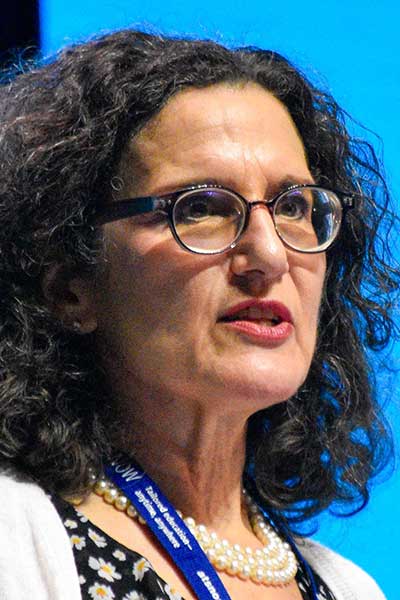
Vallerie V. McLaughlin, MD, the Kim A. Eagle, MD, Endowed Professor of Cardiovascular Medicine at the University of Michigan, presented data from the ADVANCE Outcomes trial, characterized as “incredibly exciting data” by R. Jim White, MD, PhD, professor of medicine at the University of Rochester, during the post-presentation discussion.
Dr. McLaughlin explained the rationale for the ADVANCE outcomes study: “There are a number of pathways that we use for medical therapy of pulmonary hypertension.” These therapies target prostacyclin, nitric oxide, endothelin, or activin signaling, and are often used in combination.
However, there is an unmet need for more convenient options that can modify the disease trajectory.
ADVANCE Outcomes was a global, randomized, double-blind, placebo-controlled, event-driven phase 3 trial that assessed the efficacy of the potent, once-daily, oral highly selective prostacyclin receptor agonist ralinepag in patients with WHO Group 1 PAH.
When added to PAH standard of care or PAH-specific stable background oral therapy, ralinepag reduced the risk of clinical worsening by 55 percent compared with placebo. The trial met its primary endpoint of delayed time to first clinical worsening, with the treatment effect driven primarily by disease progression.
The clinical benefit of ralinepag was consistent across subgroups, regardless of time since diagnosis, disease etiology, baseline 6MWD, WHO functional class (FC), NT-proBNP levels, and the use of background therapies.
Clinical improvements were durable, with a shift to milder WHO FC compared with baseline at week 28.
Dr. McLaughlin reviewed the safety profile, which was consistent with prostacyclin-related adverse events.
A Phase 3 Trial in Front-Line Mycobacterium Avium Complex Lung Disease

Charles L. Daley, MD, ATSF, professor of medicine at National Jewish Health, framed the unmet needs in MACLD, explaining, “MAC is a very difficult disease to manage. There are many gaps that exist in our evidence base and the best ways to treat MAC, particularly in terms of achieving durable culture conversion and improving symptoms in our patients.”
ALIS, an aminoglycoside antibacterial, is currently approved in the United States as a component of a multidrug regimen for adults with relapsed or refractory MACLD.
Based on its efficacy in pretreated MACLD, researchers designed the ENCORE trial to assess ALIS in the frontline setting in newly diagnosed MACLD.
In ENCORE, the largest randomized study in the newly diagnosed setting, a fixed treatment duration with ALIS was employed. Adults with MACLD, with a positive MAC culture within six months before and at screening, and an average Quality of Life-Bronchiectasis (QOL-B) respiratory symptom domain score (RSS) ≤85, received either ALIS with azithromycin and ethambutol or empty liposome control placebo with azithromycin and ethambutol.
The QOL-B is a self-administered, patient-reported outcome measure for assessing symptoms, functioning, and health-related QOL in patients with bronchiectasis.
Treatment was administered once daily for 12 months, followed by three months without therapy. The primary endpoint was the change from baseline in RSS at month 13.
In the moderately symptomatic population enrolled in ENCORE, of whom the majority (more than 80 percent) were truly treatment-naïve for MACLD, the ALIS-containing regimen yielded a greater improvement in RSS. The RSS improvement was greater three months after cessation of treatment. The treatment difference in RSS was 3.11 at month 13 and 4.8 at month 15.
Analysis of secondary outcomes showed that ALIS also yielded higher culture conversion rates at months 6, 12, and 13, which remained durable at month 15. Culture conversion is an important endpoint for patients and providers alike, and ENCORE used more stringent criteria for culture conversion.
“ENCORE is the first study in MACLD to use a validated patient-reported outcome as a primary endpoint,” Dr. Daley concluded.
Inhaled Treprostinil for the Treatment of Idiopathic Pulmonary Fibrosis

Treprostinil is a synthetic stable analogue of prostacyclin that has anti-inflammatory and anti-fibrotic effects, in addition to promoting vasodilation of pulmonary and systemic blood vessels.
Various formulations of treprostinil are approved for treating patients with PAH and PAH associated with interstitial lung disease.
In the phase 3 TETON-1 trial, inhaled treprostinil elicited a statistically significant placebo-corrected change in forced vital capacity (FVC) of 130.1 mL from baseline to Week 52 in patients with IPF.
Steven D. Nathan, MD, professor of medicine at the University of Virginia and director of the Advanced Lung Disease and Lung Transplant Program at Inova Fairfax Hospital, shared these findings.
Dr. Nathan outlined the rationale for the TETON clinical trial program, which includes two replicate 52-week phase 3 randomized controlled trials in 1,195 patients with a confirmed diagnosis of IPF.
TETON-1 enrolled 598 patients with IPF at various centers in the United States and Canada, while TETON-2 enrolled 597 patients with IPF in the Asia-Pacific, Europe, and Latin America.
The previously completed TETON-2 trial showed that treatment with inhaled treprostinil resulted in a smaller decline in FVC, compared with placebo. Patients who received treprostinil therapy also had fewer clinical worsening events over the 52 weeks.
Consistent with TETON-2 findings, “the effect of treprostinil is the same across the background therapy groups,” and across the study period, Dr. Nathan said.
The FVC change from baseline to Week 52 was 98.7 mL, 123.4 mL, and 168 mL in patients without any background therapy, with background nintedanib, and pirfenidone.
The key take-home message from the secondary endpoint analyses, Dr. Nathan said, is that treprostinil is associated with a 33 percent risk reduction in time to clinical worsening compared to placebo.
Aroxybutynin and Atomoxetine (AD109) in Obstructive Sleep Apnea: A Pooled Analysis of the SynAIRgy and LunAIRo Trials

A pooled analysis of data from the SynAIRgy and LunAIRo phase 3 randomized, double-blind, placebo-controlled trials in adults with mild-to-severe OSA who were intolerant to or refused positive airway pressure (PAP) therapy, AD109 improved Apnea-Hypopnea Index (AHI) scores, airway obstruction, and oxygenation.
These exciting findings were shared by Sanjay R. Patel, MD, MS, ATSF, professor of medicine, epidemiology, and clinical and translational science at the University of Pittsburgh, and Patrick J. Strollo, MD, ATSF, professor of medicine and clinical and translational science at the University of Pittsburgh.
Dr. Patel reviewed the significant unmet need for diagnosis and treatment of OSA, noting that among diagnosed patients, only 74 percent receive positive airway pressure (PAP) therapy, and only 37 percent of PAP recipients adhere to treatment.
Patients prefer oral therapy over PAP; however, no oral pharmacologic treatments have been approved to date for OSA.
The 26-week SynAIRgy and 51-week LunAIRo trials evaluated the safety and efficacy of AD109, an investigational fixed-dose oral anti-apneic neuromuscular modulator that combines two drugs in one tablet administered orally — the novel antimuscarinic aroxybutynin and atomoxetine, a selective norepinephrine reuptake inhibitor.
Across the two trials, 1,299 patients with an AHI score >5 (AHI4; 4 percent hypopnea desaturation) and body mass indices (BMIs) of 18.5-40 kg/m2 (males) and 18.5-42 kg/m2 (females) were enrolled.

The pooled analysis included data at Week 26, in both the treatment policy and on-treatment estimands.
AD109 reduced AHI4 in the treatment policy estimand (mean difference of −4.0), representing a model-estimated 39.3 percent reduction from baseline; the mean difference and model-estimated reduction from baseline in the on-treatment estimand analysis were −6.2 and 51.6 percent.
The improvement was consistent across subgroups. Notably, OSA was resolved in 23 percent of patients in the pooled analysis.
Dr. Strollo also discussed findings related to improved oxygenation and snoring, measures that go beyond assessing the frequency of disordered breathing events via AHI.
Oxygenation improved with AD109 therapy in 60 percent of patients, as assessed using HB4 (hypoxic burden based on ≥ 4 percent blood oxygen saturation), which reflects both the severity and length of each hypoxic drop. Improved oxygenation can reduce the risk of cardiovascular disease (CVD) and mortality in patients with OSA, a patient population at significantly higher risk of CVD and mortality.
AD109 treatment also improved loudness and frequency of snoring from baseline in 70 percent of patients. Patient-reported outcomes of fatigue and daytime sleepiness also improved.
“AD109 is designed to target sleep-related neuromuscular dysfunction, a root cause of OSA affecting all patients, and it is a first-in-class drug to address this. If approved, AD109 may be a treatment for patients who do not tolerate or refuse PAP therapy, with utility across all levels of disease severity and weight classes,” Dr. Strollo concluded.
Extend Your ATS 2026 Experience with ATS NOW

ATS NOW offers conference highlights, peer-reviewed sessions, and access to leading experts in pulmonary, critical care, and sleep medicine. ATS 2026 attendees receive complimentary access to the platform through the rest of the calendar year!