



Robert Wachter, MD, led Sunday’s Opening Ceremony of the ATS 2026 International Conference with an examination of how artificial intelligence (AI) is transforming health care. Dr. Wachter, a professor and chair of the Department of Medicine at the University of California, San Francisco, coined the term “hospitalist” in 1996 and is widely credited as the father of the hospitalist field, the fastest-growing specialty in modern medicine.
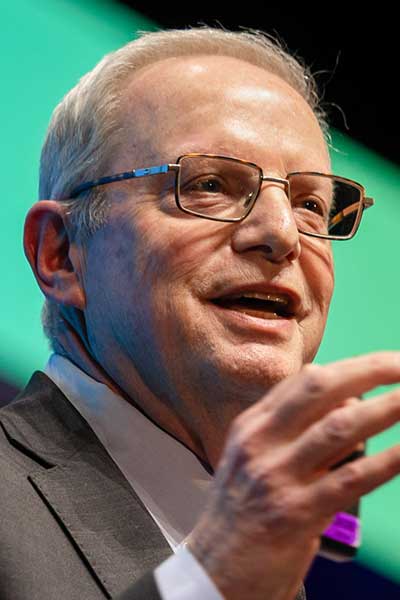
Drawing on insights from his second book, A Giant Leap: How AI is Transforming Healthcare, Dr. Wachter’s message was clear: “Artificial intelligence in health care has moved swiftly from an experimental curiosity to an essential, rapidly evolving clinical tool — bringing both promise and risk.” He framed his perspective as an “engaging hype-free case for informed optimism,” emphasizing that while AI in health care is not without flaws, its trajectory is overwhelmingly positive for clinical care.
A major theme of Dr. Wachter’s talk was the unprecedented speed of progress. He described how his own learning curve with AI began with the Nov. 30, 2022, release of ChatGPT, which he said initially seemed interesting. Within months, his interest grew, as studies showed systems passing licensing exams; shortly afterward, they matched expert clinicians on complex diagnostic cases.
“Most strikingly, later research demonstrated that AI alone outperformed both physicians and physicians assisted by AI, achieving diagnostic accuracy rates far exceeding human-only performance,” Dr. Wachter said. This shift, he noted, is sobering when one considers how quickly the technology is improving.
From a clinical workflow perspective, AI has already begun to embed itself in routine care. He highlighted tools such as AI scribes, chart summarization systems, and clinical decision support platforms. These address longstanding inefficiencies: documentation burden, information overload, and inability to synthesize rapidly expanding medical literature. For example, he points out that “One out of five patient records is longer than Moby Dick,” making traditional human-only reviews impractical. AI’s ability to summarize such records represents a meaningful operational breakthrough.
Despite these gains, Dr. Wachter underscored persistent concerns. Early issues like hallucinations and bias remain, but have improved significantly, with errors now occurring far less frequently. However, newer challenges — particularly privacy, security, and misinformation — pose serious risks. He stressed that AI-generated content can convincingly fabricate statements or clinical guidance. “The thing I’m most worried about of all is mis- and disinformation.”
The evolving “human-in-the-loop” model is emerging as a central tension, he explained. AI is now reliable enough to be useful but not flawless enough to be trusted independently. “We find ourselves in this sort of uncomfortable middle space where the AI now is correct often enough to be useful and not perfect enough to be entirely trusted,” Dr. Wachter explained. This creates new responsibilities for clinicians, who remain accountable for final decisions even as AI increasingly shapes them.
Another concern is clinician de-skilling. Early evidence suggests that reliance on AI tools may degrade clinical skills when those tools are removed. He cited emerging studies showing performance declines after short-term AI use, raising important questions for training and long-term competency.
On workforce implications, Dr. Wachter offered reassurance. While administrative and clerical roles may shrink, he argues that frontline clinicians will not be replaced in the foreseeable future. Instead, AI will augment decision making and shift professional roles toward more complex, interpretive, and patient-centered activities.
This moment is a turning point in medicine’s digital transformation, Dr. Wachter said. Borrowing a concept from Hemingway’s The Sun Also Rises, he concluded that change in health care will happen “gradually and then suddenly,” urging clinicians to engage actively with AI tools rather than resist them.
Before Dr. Wachter’s lecture, ATS President Raed Dweik, MD, MBA, ATSF, delivered a “State of the Union” address, saying that “the problem in science is we play it safe. We go to the next step to the next step to the next step. Sometimes it’s remarkably successful, but why shouldn’t a certain percentage of the investment in science go for the home run? What if you risk everything for a cure?”
With that, Dr. Dweik went on to describe the tireless work being done by patient groups and not- for-profit organizations that “Provide a reality check to clinicians and scientists that this is personal. Their commitment to help us and inspire us is pivotal.” He acknowledged the Public Advisory Roundtable (PAR) founder, William Martin II, MD, who established the group 25 years ago, and prioritized incorporating the patient voice into the heart of the medical organization.
“Over the next 25 years, I see PAR having an even larger role within the ATS,” Dr. Dweik said. “There are still so many issues that need to be addressed, and research is going to be the key. It can be the beginning of just those incredibly powerful, impactful relationships moving forward.”
The Opening Ceremony also honored multiple 2026 Respiratory Health Award recipients.
The ATS thanks Boehringer Ingelheim Pharmaceuticals, Inc. for their generous support of the ATS 2026 Opening Ceremony.
Extend Your ATS 2026 Experience with ATS NOW

ATS NOW offers conference highlights, peer-reviewed sessions, and access to leading experts in pulmonary, critical care, and sleep medicine. ATS 2026 attendees receive complimentary access to the platform through the rest of the calendar year!