



Charles G. Irvin, PhD, ATSF, vividly recalls the first time he saw the inside of living human airways. He was a grad student in the 1970s at the University of Wisconsin and heard the doctors buzzing with excitement because they had just received their clinic’s first flexible bronchoscope. For the first time, and under better conditions for the patients, they were able to improve lung assessments compared with the old fixed bronchoscopes.
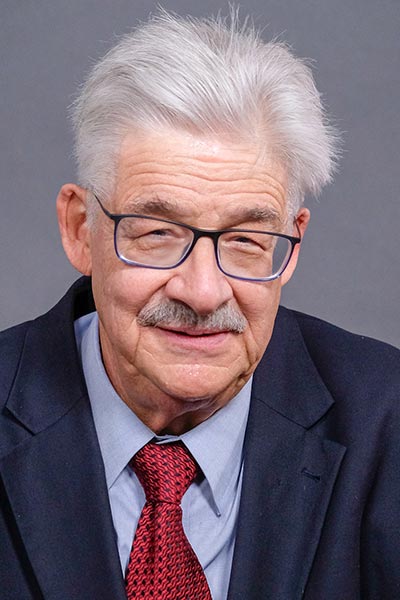
“I had asked if I could hang out the next time that they used it and one of the docs said, ‘Absolutely!’ So, that afternoon I’m looking inside the airways of a patient in total amazement,” Dr. Irvin recounts from his office at the University of Vermont as his hands mimic the motions of the airways dilating and constricting with each breath, “You could even see the pulsations of the structures due to the heart beating — very cool! And then, since we were looking into the airways of a patient with asthma, there were bubbles, there was mucus, there was all this stuff in the airways. It was a total mess!”
That day didn’t define the career of the future Dr. Irvin, but remains a thrilling memory and fed a sense of curiosity and amazement, along with a respect for the actual, living patient on the other end of the bronchoscope, which has characterized a long, productive career that led to receiving the ATS Edward Livingston Trudeau Medal of Honor — the Society’s highest honor — on Saturday, May 16, during the Opening Ceremony of the ATS 2026 International Conference.
Research
Dr. Irvin is an internationally renowned applied physiologist who studies lung mechanics, airway biology, and clinical trials of asthma/COPD treatments. His lifelong research has focused on the mechanical and cellular dysfunction underlying airway diseases (such as asthma), as well as determining how inflammation, smooth muscle control, and epithelial integrity drive airway hyperreactivity. His seminal contributions include identifying the non-adrenergic inhibitory neural system in the lung; defining the role of neutrophilic and eosinophilic inflammation in airway dysfunction, which form the basis for anti-inflammatory therapy in asthma; and defining the mechanistic link between sinus/nasal inflammation and lower airway hyperreactivity, supporting the one-airway concept.
Dr. Irvin’s innovations in methodology have transformed pulmonary research, including his pioneering applications of precision lung function assessments in laboratory animals and an antigen sensitization system that is widely used today. Lastly, his research has shown that airway closure, not airway narrowing, is the primary mechanism by which lung function is impaired in asthma and other airway diseases.
“Near the end of my graduate training, we were doing a project on veterans who had COPD. The patient had just performed two reasonably reproducible flow-volume loops and then gave a big, productive cough. The next flow-volume loop was nearly doubled in size. I can’t think of a better example of airway closure!” Dr. Irvin recalled.
These types of general observations led Dr. Irvin, then a PhD student, to begin measuring lung function using small pressure oscillations, a line of inquiry he continues to this day through various research, including with the NIH/American Lung Association Lung Health Cohort Study focusing on determinants of lung function in young populations and a Vienna-based LEAD study of more than 15,000 patients examining whether abnormalities in measurements beyond the use of simple spirometry such as lung volumes and forced oscillations will yield more sensitive and specific insights into the origins of lung disease.
Dr. Irvin said that his research approach begins with curiosity, having a genuine interest in fundamental questions about how the human body — particularly the lung — has evolved to function, and how researchers can best measure and characterize these functions.
“You have to remember, the lung is a real pain to study,” Dr. Irvin said with a smile. “It’s a very complicated structure. It’s not a flow-through system where you can put a catheter at one end and another catheter at the other end and then simply measure the difference and say, ‘Well, that’s what a lung does.’ Gas goes in and out of the same passages. Moreover, the lung’s airways are so small, and their contribution to resistance is negligible; yet that is where lung disease typically starts, you can have a profound effect in the depths of the lung without seeing any difference in standard lung function tests.”
However, Dr. Irvin added that the challenging nature of studying and measuring the lungs is what he finds most rewarding for him and his colleagues. He also noted that while research must focus on important questions and rigorous standards, it is important not to lose sight of how these seemingly eclectic measurements can be applied to patient diagnosis and treatment, to improve their overall condition.
Service and Drive
Parallel to his long and persistent career achievements in the fields of research, academics, and clinical practice, Dr. Irvin has continued to dedicate time to professional service, including with the ATS, which he joined as a student in 1974 because he was told the Society welcomed young professionals in its committees and working groups.
“And only 10 bucks! I got the journal and everything — best 10 bucks I ever spent,” Dr. Irvin said about paying the membership fee at the time. “I started going to the meetings, then I was on this committee and that committee. I made friends, met colleagues, met people who wrote me letters of recommendation — the ATS was a godsend for my career.”
Over the years, Dr. Irvin has given back to the ATS through service in numerous positions, such as chair of the RSF Assembly, chair of the Long-Range Planning Committee and chair of the Awards Committee, as well as serving on the Nominating Committee, Education Committee, Long-Range Planning Committee, Careers Task Force, ATS Board of Directors, the ATS Working Group for PhD Member Interests, the ATS Workshop on Race and PFTs (pulmonary function tests), ten PFT Proficiency Standards documents committees, and more.
“I always said ‘yes,’” he explained.
Service within the field, collaboration with colleagues across the globe, and rigorous standards of scholarship are key career values that Dr. Irvin has shared with students and trainees he has worked with over the years. But he said the core of a successful researcher is something that can’t be taught — and it goes back to the thrill he felt as a young student peering through a bronchoscope for the first time.
“It’s all about whether you have the passion, or not,” Dr. Irvin said. “You have to have some kind of drive, something that makes you curious, something that makes you want to make a difference.”
Extend Your ATS 2026 Experience with ATS NOW

ATS NOW offers conference highlights, peer-reviewed sessions, and access to leading experts in pulmonary, critical care, and sleep medicine. ATS 2026 attendees receive complimentary access to the platform through the rest of the calendar year!