



The shared mechanism behind two emerging idiopathic pulmonary fibrosis (IPF) treatments remains a promising area for further study as researchers continue to search for the holy grail of fibrosis resolution, said Marc Peters-Golden, MD, during the J. Burns Amberson Lecture on Sunday at the ATS 2026 International Conference.
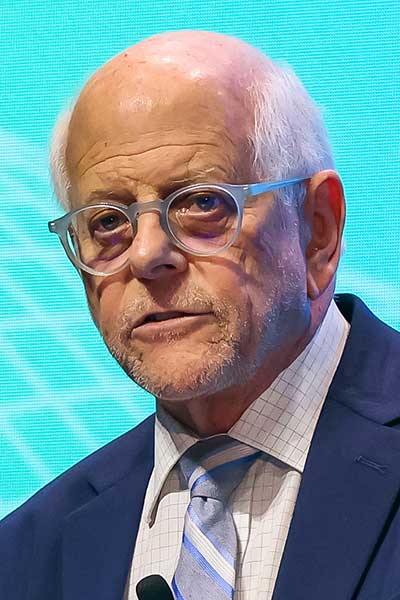
During the lecture, Dr. Peters-Golden shared the rationale and mechanistic basis for cyclic adenosine monophosphate (AMP)-elevating therapies, including nerandomilast and treprostinil, and discussed future possibilities for similar approaches. He also reflected on personal lessons learned from decades of mentorship and research at the University of Michigan, from which he recently retired.
Being named the 2026 J. Burns Amberson Lecturer was “very obviously the honor of my career,” Dr. Peters-Golden said, following an introduction by ATS President Raed A. Dweik, MD, MBA, ATSF. The lecture, named in honor of James Burns Amberson, an international authority on chest disease and tuberculosis, recognizes major contributions to clinical or basic research that have advanced the fundamental understanding of the basic, translational, or clinical approaches to respiratory disease, critical illness, or sleep disorders. It also recognizes exemplary professionalism, collegiality, and citizenship through mentorship and leadership in the ATS community.
Cyclic AMP, an intracellular second messenger, is generated via a variety of substances binding to G protein-coupled receptors, Dr. Peters-Golden explained. His focus has long been on the stimulation of cyclic AMP synthesis by lipid mediators, including prostaglandin E2 (PGE2) and prostacyclin. Beginning when others were searching for processes characterized by the expression of prostaglandin-related enzymes, Dr. Peters-Golden and his lab found that lung fibroblasts from patients with IPF showed deficiencies in numerous related components, as well as an increase in enzymes that degrade prostaglandin and cyclic AMP.
“It seems like the cell in a fibrotic lung has gone to a great deal of trouble to disable this pathway, and the breadth of these defects suggested to us that this axis may not only predispose to fibrogenesis when it’s downregulated, but it may actually be necessary for fibrosis to occur,” Dr. Peters-Golden said.
“Its loss may be just as essential for fibrogenesis as the loss of tumor suppressors is for cancer development,” he continued, “and our finding and the implications motivated what became for me a 30‑year endeavor to understand the mechanisms and the impact of PGE2 in fibroblasts, in particular, in the context of pulmonary fibrosis.”
Fibrosis research has often strived to identify and inhibit individual profibrotic drivers, Dr. Peters-Golden said, expressing skepticism that blocking so many redundant drivers would be efficacious, as evidenced by the landscape of failed clinical trials.
“What’s interesting about cyclic AMP is that it inhibits all of these drivers,” he said. “It truly is ‘the one anti-fibrotic brake to rule them all,’ and this is a situation where I think pleiotropy is more valuable than precision medicine.”
Although Dr. Peters-Golden warned that the feasibility of fibrosis resolution in patients with IPF remains aspirational and speculative, he shared examples of spontaneous resolution that occur in certain animal models of fibrosis. A mouse model studied in Dr. Peters-Golden’s lab showed that cyclic AMP signaling in fibroblasts is necessary for spontaneous resolution, which led to an exploration of the events necessary for resolution to occur. At the very least, he said, that should include clearing out the pathogenic fibroblasts, clearing out the collagen, and regenerating the alveolar epithelium.
While it has been gratifying to see cyclic AMP-elevating strategies come to the clinic, Dr. Peters-Golden said now is not the time to move on from this area of study.
“We still have dragons to slay, mountains to climb, in terms of resolution, and I think it would be really foolhardy and naive to think that nerandomilast or treprostinil represent the epitome of what can be accomplished by tweaking the cyclic AMP pathway,” he said. “There are many, many other approaches that could be considered.”
Dr. Peters-Golden closed with several personal reflections. He thanked his many mentees for fulfilling a mentorship connection he had never experienced. “Sharing the pursuit of science with them made the research better and made the journey infinitely more enjoyable.” He also expressed concern about support for important scholarship that has been consigned to the margins. “Can an already tenuous biomedical research system support someone like me today?” Finally, he recognized his colleagues and family for the roles they’ve played in his life. “I could never have imagined the success I’ve had, how rewarding my career would be, or how much joy it has brought me, and for the reasons I’ve shared with you today, I think you can see that I could never, ever have imagined today.”
Extend Your ATS 2026 Experience with ATS NOW

ATS NOW offers conference highlights, peer-reviewed sessions, and access to leading experts in pulmonary, critical care, and sleep medicine. ATS 2026 attendees receive complimentary access to the platform through the rest of the calendar year!